
On 26 March 2026, the SafeCREW Final Conference in Brussels united experts from water utilities, policy, research, and industry. Hosted at the Hanse Office, the event blended external insights with project outcomes—new tools, risk assessment frameworks, and climate-resilient strategies—fostering dialogue on safe drinking water management and addressing today’s challenges and tomorrow’s solutions.
The core programme contained six presentations from SafeCREW researchers covering all key results. At the same time, SafeCREW featured the work of the ZeroPollution4Water Cluster by inviting Water Europe and the sister projects H2OforAll and intoDBP to contribute their project outcomes and insights. To complement the programme with external perspectives from policy, SafeCREW invited speakers from the European Commission (EC), the European Research Executive Agency (REA), the European Parliament (EP) and the WHO Regional Office for Europe (WHO-EU). Though the two members of European Parliament had looked forward to sharing their views on the European Water Resilience Strategy, however they had to cancel on short notice due to an important plenary debate at the EP.
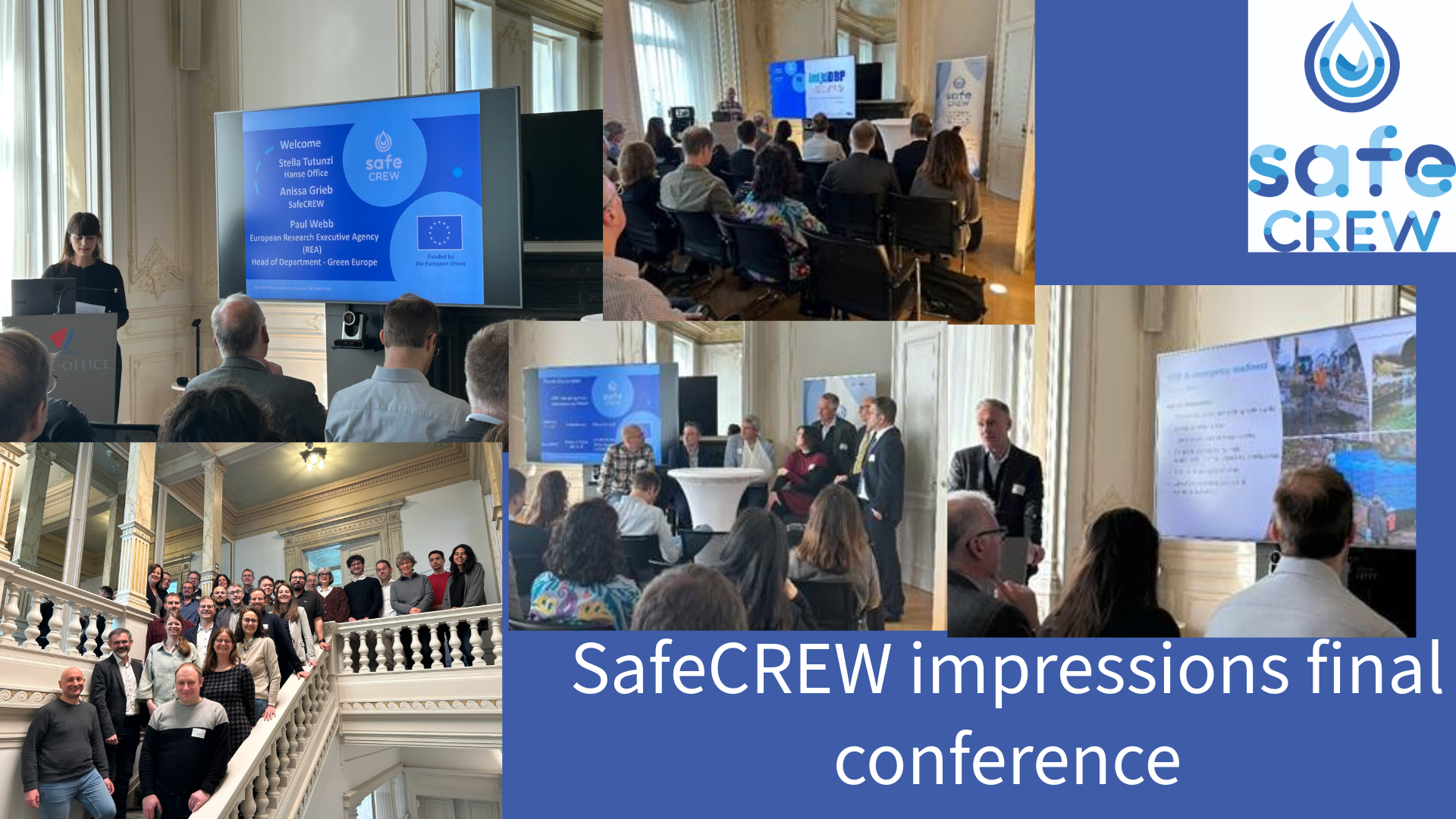
Impressions from the SafeCREW Final Conference, including the panel discussion (© Tutech)
In his welcome speech, Paul Webb, Head of Department for “Green Europe” research at European Research Executive Agency (REA) and Acting Director, emphasised the importance of aligning policy and technological development, noting the growing public concern over drinking water quality, as highlighted by recent elections in Denmark. He also highlighted the importance of the work of the ZeroPollution4Water Cluster.
Oliver Schmoll from the WHO Regional Office for Europe then presented on Water Safety Plans (WSP). He stressed that water safety is integral not only to SDG 6 (clean water and sanitation) but also to SDG 3 (health and well-being), as unsafe Water, Sanitation, and Hygiene (WASH) are linked to an estimated 33,000 deaths annually in the EU. WSPs aim to overcome limitations of testing drinking water only at the final product stage and are promoted under the EU Drinking Water Directive. Schmoll also mentioned ongoing WHO efforts to support water infrastructure resilience in Ukraine amid conflict, including a preparedness checklist. The following five presentations covered the work of SafeCREW, intoDBP and H2OforAll on tools to monitor and analyse DBPs and DBP precursors, risk assessment frameworks and the management of drinking water distribution networks.
panel discussion “DBP risk mitigation – presence and future“
The panel discussion “DBP risk mitigation – presence and future“, moderated by Gabry Ostuni (MSS), was one of the highlights of the conference. Wolfgang Gernjak (ICRA, intoDBP), Irene Jubany (Eurecat, SafeCREW), Rui Martins (Uni Coimbra, H2OforAll), Oliver Schmoll (WHO-EU), Bertrand Vallet (DG-RTD) and Andrea Rubini (Water Europe, ZP4W Cluster) explored the future relevance of Risk Management Plans versus innovative monitoring tools for DBP control. Key points included the complementary nature of soft sensors and traditional measurements — soft sensors inform operators on emerging risks while regulatory compliance requires direct measurement. Participants stressed the need to avoid over-regulation, focus on guidelines addressing relevant health risks, and ensure data sharing to enhance model confidence. The panel highlighted challenges faced by small water supply systems, advocating for tailored guidelines and new operational skills. Artificial intelligence (AI) was recognised as a promising tool to support plant operations and optimise treatment parameters, especially in small systems struggling with regulatory implementation.
Three SafeCREW presentations followed lunch, including a presentation by NUWEE on transferring the SafeCREW methods to Ukraine, noting differences between EU and Ukrainian standards, including aspects like microplastics and PFAS regulations. The concluding remarks by Sofia Pachini (REA) and Anissa Grieb (DVGW-TUHH) emphasised the broader context provided by the panel discussions and WHO presentations. They highlighted the importance of applying research results also to small and less-developed water supply systems across the EU, which has just started.
Held at the Hanse-Office – the joint representation of the city of Hamburg and the federal state of Schleswig-Holstein in Brussels, the conference facilitated the participation of the European institutions based in Brussels and connected between policy and the water community. It attracted 48 participants, including Belgian water utilities, water technology providers and associations like Aqua Europe, Aqua Flanders, Aqua Publica Europe and Water Europe.
Presentations
- The SafeCREW project – introduction (Anissa Grieb, DVGW-TUHH)
- Water Safety Plans (Oliver Schmoll, WHO Regional Office for Europe, European Centre for Environment and Health)
- SafeCREW: Management solutions for drinking water distribution networks under climate change (Irene Jubany, Eurecat)
- intoDBP: Innovative tools to control organic matter and disinfection by-products from source to tap (Wolfgang Gernjak, ICRA)
- SafeCREW: Occurrence of novel highly polar sulfonated disinfection by-products in drinking water (Maolida Nihemaiti, UFZ)
- SafeCREW: Risk management framework and monitoring solutions supported by soft sensors (Manuela Antonelli, POLIMI)
- H2OforAll:I nsights and achievements of the project (Rui Martins, University of Coimbra)
- SafeCREW: Guideline for implementing disinfection in drinking water supply systems (Cynthia Kalweit, UBA)
- SafeCREW: Chemical-free regeneration of macro-porous anion-exchange adsorbers for the removal of Natural Organic Matter (NOM) (Mathias Ernst, DVGW-TUHH)
- SafeCREW: Transferring methods to Ukraine (S.Y. Martynov, NUWEE)
- Wrap-up and concluding remarks (Sofia Pachini, REA & Anissa Grieb, DVGW-TUHH)
Further information about: