New monitoring tools for comprehensive water quality characterisation
SafeCREW will provide a combined set of complementary and flexible tools that will overcome still existing hurdles in chemical, toxicological and microbiological characterisation of water:
Combined Fluorescence spectroscopy (with PARAFAC) and LC-OCD/-UVD/-OND and FT-ICR-MS for improved NOM characterisation models
Characterising the complex, heterogeneous natural organic matter (NOM) in drinking water is challenging. SafeCREW combined UV absorbance, fluorescence spectroscopy, LC-OCD, and LC-FT-ICR-MS, demonstrating these complementary techniques enable systematic assessment of NOM composition and reactivity. They link specific NOM characteristics to the formation of regulated and emerging disinfection by-products (DBPs). This supports water utilities in optimising treatment for NOM removal and DBP control, and aids researchers in identifying DBP precursors and formation mechanisms. Results are described in the SafeCREW Analytical Protocol #2 and Deliverable D1.2.
Improved detection of polar DBPs by using Supercritical Fluid Chromatography SFC coupled to High Resolution Mass Spectrometry (HRMS)
DBP formation is usually analysed using gas chromatography and reversed phase liquid chromatography coupled to mass spectrometry, overlooking very polar DBPs and thus a significant portion of total DBPs. SafeCREW developed a new method using supercritical fluid chromatography coupled with high-resolution mass spectrometry to identify sulfonated DBPs, providing water utilities and policymakers with improved tools to enhance monitoring, treatment processes, and regulatory guidelines. Results are described in the SafeCREW Analytical Protocol #1, Deliverable D1.1 and the EU Innovation Platform.
Affordable and reagent-free THM sensor for online monitoring of the four main THM
At project start, existing methods for detecting trihalomethanes (THMs) were time-consuming, costly, and unable to differentiate THMs. SafeCREW developed an electronic nose system that uses sensor arrays and artificial neural networks to rapidly detect and differentiate the four main THMs in drinking water, with a view of offering water utilities a more efficient, cost-effective tool to monitor THM variations and improve water safety. The instrument is in the latter stages of development, and market launch is currently planned for 2027.
Integration of CALUX bioassays as early warning system for toxicity in complex water mixtures
Knowledge on the toxicity of DBPs is still limited. SafeCREW accomplished in vitro toxicity testing for known and unknown DBPs in complex mixtures in source and drinking water via high-throughput, non-animal bioassays, enabling water utilities to monitor harmful effects, support risk-based treatment interventions, and provide policymakers with data to update regulations for safer, toxic-free drinking water. Results are described in SafeCREW Analytical Protocol #3, Deliverables D1.3, D2.5, D4.3 and the EU Innovation Platform.
Passive sampler for effective microbial monitoring for early warning
Current microbial monitoring relies on grab sampling and detects contamination only at advanced stages. SafeCREW developed a proof-of-concept passive sampler capable of measuring time-averaged pathogen concentrations, accounting for water temperature, materials, and microbial strains. Targeting drinking water systems, where microbial concentrations are typically low, it enables the development of early-warning systems. Results are presented in Deliverable D1.4.
Microbial log-removal estimation in low concentration systems for application in managed aquifer recharge wells (MAR)
Detecting pathogens in groundwater is challenging due to their low concentrations and the need for large sample volumes for reliable Quantitative Microbial Risk Assessment. SafeCREW implemented ultrafiltration modules to concentrate microorganisms from large volumes, improving pathogen detection accuracy and providing water utilities and policymakers with more reliable data to enhance monitoring programs and risk management for safer drinking water. Results are described in Deliverable D2.1.
New processes for reducing disinfection by-products
Five novel treatment processes to actively respond to identified threats were developed to upgrade drinking water treatment processes according to a multi-barrier approach for non-disinfected and for disinfected drinking water supply systems.
Adsorptive membranes to selectively remove NOM and reduce DBP formation coupled with a sustainable elctrochemical regeneration method
Conventional ion-exchange materials for removing NOM require chemical regeneration or disposal after use, limiting sustainability. SafeCREW developed an NOM adsorber membrane process with reagent-free electrochemical regeneration using extremely low electrical current to restore adsorption capacity. The new process has considerable potential for upscaling to provide water utilities with a sustainable, low-waste solution for NOM removal that reduces chemical use and operational costs. It can be integrated into existing treatment systems. Results are described in Deliverable D2.2 and the Horizon Results Platform.
OptimiSed Advanced Oxidation Processes (AOP) techniques targeting DBP precursors
Conventional advanced oxidation processes (AOPs) typically act non-selectively, transforming a wide range of NOM fractions without specifically targeting those that predominantly generate disinfection by-products (DBPs). Within the SafeCREW project, an enhanced oxidation approach was developed, focusing on DBP-specific precursors. This method was tested using real drinking water from Case Study #3 (Tarragona). When combined with a post-adsorption step, the process effectively reduces the key precursor fractions responsible for DBP formation. This novel approach can be implemented by water utilities to improve water quality management, particularly in systems where NOM composition exhibits high variability. Results are described in Deliverable D.2.4.
Conventional and innovative materials for the removal of DBPs and their precursors
Activated carbon removes NOM and reduces DBPs but is less effective for polar compounds. SafeCREW developed two complementary solutions: guidelines for optimised carbon selection and process design in groundwater treatment, and tailored cellulose-based nanosponges for NOM removal. The guidelines support water utilities in achieving sustainable, cost-efficient treatment while ensuring safe drinking water under climate change pressures. Results are described in Guideline #1, Deliverable D2.3 and the Horizon Results Platform.
Improved NOM adsorption to activated carbon (AC) by combining with pre-chlorination
Current activated carbon (AC) selection and operational protocols often overlook seasonal variations in natural organic matter (NOM), reducing the effectiveness of AC in removing organic matter and disinfection by-product (DBP) precursors. Within the SafeCREW project, an innovative protocol was validated using both synthetic and real water matrices from Tarragona (Case Study #3). The approach combines pre-chlorination followed by AC adsorption, enhancing the adsorption of DBP precursors and ultimately reducing DBP formation during post-chlorination. This protocol offers strong potential for broad implementation, particularly in both new and existing drinking water treatment plants aiming to reduce DBP formation with minimal modifications to existing infrastructure and operational practices. Results are described in SafeCREW Guideline #1.
Automatic control for NOM removal in flocculation systems
Coagulation-flocculation control currently relies on discrete setpoints based on water turbidity and lab tests. SafeCREW developed improved automatic control for targeted NOM removal in coagulation-flocculation systems. NOM removal models were developed and implemented in Tarragona’s drinking water treatment (Case Study #3) with successful initial tests. Further upgrades for independent coagulation and flocculation dosage and online monitoring are planned. The replication by water utilities is high as they will benefit from better control of their treatment processes.
Strategies for safe drinking water distribution to avoid water quality deterioration up to final consumers
SafeCREW developed tools to overcome the multiple challenges around proper handling of DWDN and investigated links between quality of distributed drinking water and boundary conditions:
Soft sensors for DBP monitoring in drinking water
Conventional sensors measure surrogate parameters, while DBP monitoring remains costly and infrequent. Leveraging advances in machine learning, SafeCREW developed data-driven models that function as virtual sensors (soft sensors), providing real-time estimates of key water quality parameters. These tools improve anomaly detection, optimise disinfection, and support risk-based management, enabling cost-efficient delivery of safe drinking water. Results are described in Guideline #2, Deliverable D4.2 and on the Horizon Results Platform.
DBP prediction models in DWDN for the case study in Tarragona (surface water)
Predicting the formation of harmful disinfection byproducts in distribution networks disinfected with sodium hypochlorite is challenging. Within SafeCREW, advanced mathematical models and modelling strategies were developed, integrating reaction kinetics with on-line monitoring data including hydraulic and water quality parameters. These tools enable accurate prediction of both individual and total trihalomethanes, haloacetic acids, haloacetonitriles and chlorate. Developed models are described in Deliverable D3.2 and on the Horizon Results Platform.
Optimal set-points for chlorination boosters in the network based on DBP modelling
Set-points for chlorination boosters in distribution networks are currently determined based on operator judgement to achieve target chlorine residuals. Within SafeCREW, a DBP prediction model was developed and applied to optimise free chlorine set-points at booster stations. The resulting modelling framework enables improved control of both chlorine residuals and DBP formation. Moreover, the developed models can be readily transferred to other case studies with minimal adaptation. Detailed results are presented in Deliverable D3.2 and on the Horizon Results Platform.
Validated testing protocol for reactions between disinfectants and materials
Climate change is expected to increase the need for disinfection in drinking water systems, while interactions between disinfectants and infrastructure materials remain insufficiently understood. In SafeCREW, a worst-case approach, in which materials were ground into a powder, was developed to quantify chlorine consumption, organic carbon release, and disinfection by-product formation from common drinking water materials. The results, described in SafeCREW Analytical Protocol #4 and Deliverable D1.5, support material selection, risk assessment, and regulatory development for drinking water utilities.
Integrated risk assessment framework to guide future interventions that sustain safe drinking water supply in the face of climate change
A range of supporting tools, risk assessment framework, guidelines and policy briefs have been developed based on the novel analytical methods and treatment technologies:
A set of climate change scenarios and future projections of parameters relevant for DBPs, and guidelines for tipping point identification
The impact of climate change on freshwater availability and characteristics on drinking water supply systems which may result in the need to adapt infrastructures is still understudied. SafeCREW developed a set of scenarios and models of parameters relevant for DBPs based on regional historical data, literature review and climate change projections. An estimation of the water quality variation at different horizons was made for a relevant compound to consider on disinfected drinking water supply system (DWSS) like organic matter. Results are described in Deliverable D4.1.
DWDN management based on Quantitative chemical risk assessment (QCRA) and DBP prediction models
Based on the DBP prediction models in DWDN chemical risk management is built on the predicted concentrations of DBPs in the network and the assessment of their risk for human health when water is used. This innovation consists of visualising the network not only in terms of DBPs concentration but also in terms of human health risk to increase the information of the managers to take decisions on the network and water treatment plant operation. This resulted in a water management tool for the minimisation of disinfection by-products that was developed and launched online. Results are described in Deliverable D3.3, Guideline #4 and on the Horizon Results Platform.
Integrated risk assessment framework for microbial and chemical safety in drinking water
Conventional approaches to risk assessment typically address microbial and chemical risks separately and poorly integrate effect-based monitoring, limiting public health protection. SafeCREW developed a flexible, scalable framework combining these aspects. It supports decision-making in the management of drinking water supply systems by optimising current practices and strengthening preparedness for climate-driven challenges. Results are described in Deliverable D4.3.
Policy brief to support unavoidable transition from non-disinfected to disinfected drinking water supply systems (Case Study #1)
Based on SafeCREW’s main findings, this policy brief provides evidence-based guidance for transitioning to disinfected drinking water networks, supporting decision makers and utilities in managing DBPs in water treatment and distribution systems.
Transfer of solutions to utilities – application in SafeCREW case studies
The SafeCREW case studies already implemented part of the solutions above. Examples are given below.
Optimisation of disinfection in the network (CaSE Study #2, Italy)
Early in the project, a key difficulty was balancing effective disinfection with microbiological stability, without resorting to excessive chlorination in water. To tackle this, SafeCREW designed a set of integrated online microbial monitoring tools combined with soft-sensor modeling, enabling continuous, real-time adjustment of disinfectant dosage and contact time. The approach was validated through testing in Milan (Case Study #2), ultimately offering water utilities with reliable solutions to improve water quality management, lower chemical usage, and align with evolving regulations on materials and emerging contaminants.
Integrated monitoring and water safety plans for western Ukraine (case study #4)
Water quality monitoring and water supply safety in Ukraine requires improvement and alignment with European Union standards. SafeCREW facilitated knowledge transfer through continuous partner exchange and international visits, enabling the development of Water Safety Plans and the adoption of technology (e. g. soft sensors, Flow Cytometry, etc.) to enhance water safety and introduce EU water working schemes and standards as a blueprint for future Ukrainian regulations. Results are described in deliverable D7.2.
ConceptualiSation of a Centre of Excellence for Water Management for western Ukraine (Case study #4)
In Ukraine, water supply companies use outdated technologies and equipment, which does not comply with high risk mitigation standards for providing safe drinking water. Addressing gaps in applied water R&D can be achieved through the establishment of the Centre of Excellence for Water Management (CEWM) at NUWEE, which will deepen cooperation between EU and Ukrainian research and educational institutions, and water utilities. CEWM will promote the dissemination of best water management practices, support the implementation of the EU Water Policy, and help attract additional funding. Results are described in deliverable D7.3.
Implementing novel treatment and management practices (case study #3, Tarragona)
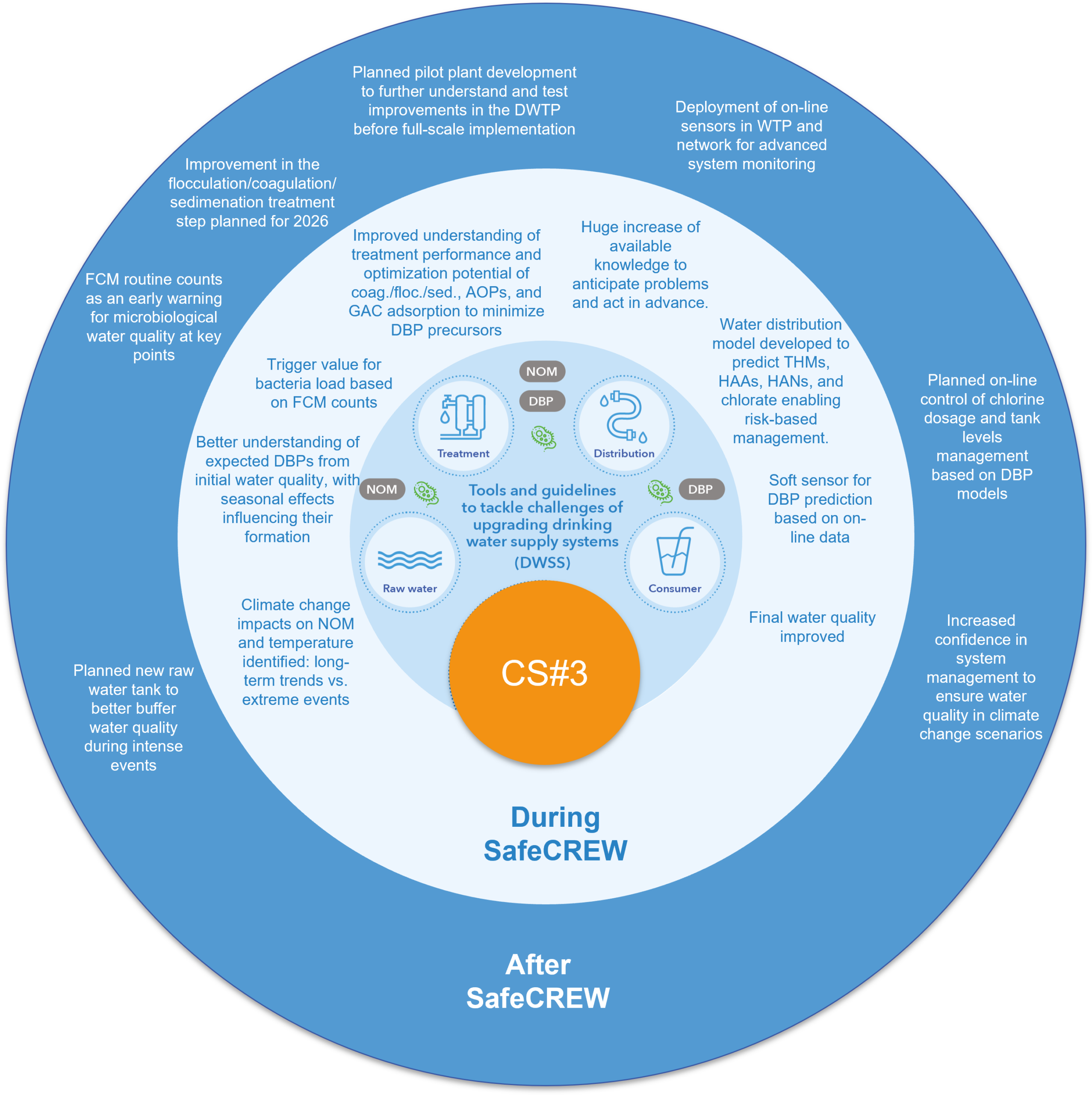
Figure 1: Development, testing and implementation of SafeCREW solutions in Case Study #3 – Tarragona, Spain. Inner light blue circles: outcomes during the project.
Outer dark blue circle: CAT’s implementation plans beyond the project.